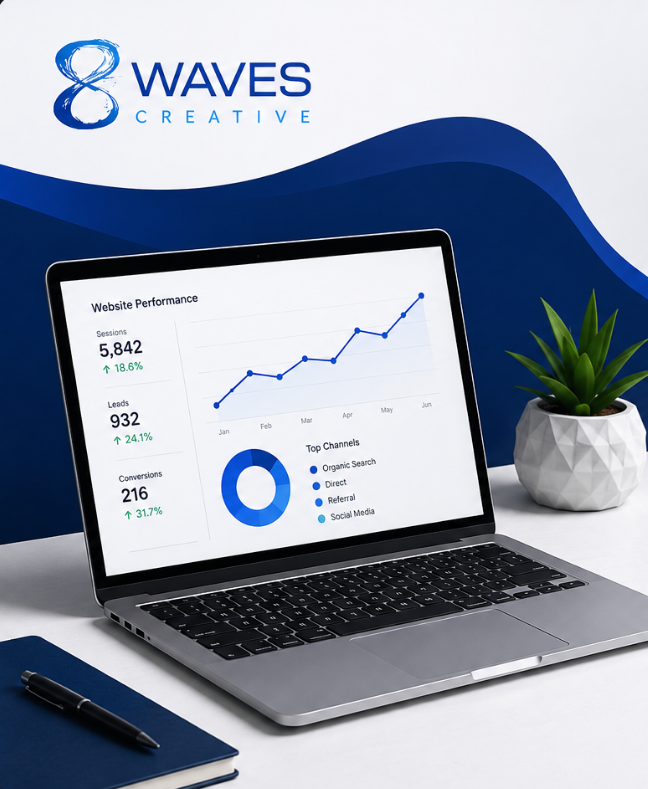



Paid Advertising has become one of the fastest ways for businesses to generate traffic, attract leads, and increase sales. Whether you’re promoting products, services, or brand awareness, paid campaigns can produce impressive results when executed correctly. However, many businesses find themselves spending significant budgets without seeing consistent returns.
At 8 Waves Creative, we’ve seen countless businesses struggle with advertising campaigns that generate clicks but fail to deliver meaningful business growth. The problem is rarely the advertising platform itself. More often, it comes down to strategy, audience alignment, tracking, messaging, and optimization.
The reality is that successful advertising requires much more than launching ads and hoping for results. Businesses that understand the factors behind campaign performance are better positioned to achieve sustainable growth and stronger returns on investment.
Understanding Why ROI Matters in Digital Advertising
Return on investment is one of the most important metrics in any advertising strategy. While impressions, clicks, and engagement can provide useful insights, they do not always reflect actual business outcomes.
Many businesses focus heavily on vanity metrics without evaluating whether their campaigns are generating qualified leads, sales opportunities, or revenue growth. A campaign that attracts thousands of visitors but produces very few conversions may not be delivering meaningful value.
Measuring ROI helps businesses understand which efforts contribute directly to their goals and which areas require improvement.
Key benefits of tracking ROI include:
- Better budget allocation
- Smarter decision making
- Improved campaign performance
- Higher conversion potential
- Sustainable business growth
Strong ROI measurement creates a foundation for long-term advertising success.
Weak Offers Often Lead to Weak Results
One of the most common reasons advertising campaigns fail is because the offer itself lacks appeal. Even the best ad creative cannot compensate for an offer that does not solve a clear problem or provide compelling value.
Consumers are constantly exposed to advertising messages. To stand out, businesses must communicate why their solution matters and what makes it different from competitors.
Without a strong value proposition, users may click but ultimately choose not to engage further.
Common offer-related issues include:
- Unclear benefits
- Generic messaging
- Lack of urgency
- Poor differentiation
- Weak customer incentives
The offer is often the single most important factor influencing campaign performance.
The Gap Between Clicks and Conversions
Many advertisers become excited when they see high click-through rates, but traffic alone does not generate revenue. The real goal is turning visitors into customers.
A significant number of campaigns fail because the landing page experience does not match the promise made in the advertisement. When visitors encounter confusing layouts, slow-loading pages, or inconsistent messaging, they often leave without taking action.
Every step after the click plays a role in conversion success.
Common conversion barriers include:
- Slow page speed
- Confusing navigation
- Weak calls to action
- Poor mobile experience
- Mismatched messaging
Optimizing the post-click experience is just as important as optimizing the advertisement itself.
Why Pay-Per-Click Advertising Requires Strategic Planning
Many businesses assume that launching Pay-Per-Click advertising automatically guarantees leads and sales. While PPC platforms offer powerful targeting capabilities, success depends on careful planning and ongoing optimization.
Effective PPC campaigns require keyword research, audience segmentation, ad testing, and performance monitoring. Without these elements, businesses may spend money reaching users who have little interest in their products or services.
Strategic planning ensures advertising budgets are invested efficiently.
Successful PPC planning includes:
- Audience research
- Keyword analysis
- Competitive evaluation
- Conversion tracking
- Continuous optimization
Preparation often determines whether campaigns succeed or struggle.
Targeting the Wrong Audience Creates Budget Waste
One of the fastest ways to reduce ROI is by targeting audiences that are unlikely to convert. Broad targeting may increase reach, but it often decreases relevance.
Not every user is at the same stage of the buying journey. Some individuals are gathering information, while others are actively searching for solutions. Delivering the right message to the right audience is essential.
Relevant targeting improves engagement and conversion opportunities.
Targeting mistakes often include:
- Broad audience selection
- Poor demographic alignment
- Weak keyword matching
- Ignoring buyer intent
- Inadequate audience segmentation
Precision targeting helps maximize advertising efficiency.
The Importance of Accurate Conversion Tracking
Many businesses unknowingly make decisions based on incomplete or inaccurate data. Without proper tracking systems in place, it becomes difficult to determine which campaigns are driving actual results.
Accurate tracking allows marketers to identify high-performing ads, landing pages, keywords, and audiences. It also helps uncover areas where budget may be wasted.
Reliable data supports smarter optimization efforts.
Tracking essentials include:
- Lead tracking
- Form submissions
- Phone call monitoring
- Sales attribution
- User behavior analysis
The better the data, the better the decision-making process.
Why Landing Pages Often Become the Weakest Link
Advertising campaigns can generate substantial traffic, but poor landing pages often prevent conversions from happening. A landing page should continue the conversation started by the advertisement.
When visitors arrive expecting one experience and encounter something completely different, trust decreases and bounce rates increase.
Consistency throughout the customer journey improves results.
Landing page best practices include:
- Clear headlines
- Strong calls to action
- Simple layouts
- Fast load speeds
- Relevant content
A well-designed landing page can significantly improve conversion rates.
Common Problems With Paid Advertising Campaigns
Many Paid Advertising Campaigns fail because businesses focus exclusively on ad creation while neglecting the larger marketing ecosystem.
Successful campaigns depend on multiple components working together, including targeting, messaging, user experience, tracking, and follow-up processes.
Even a small weakness in one area can impact overall performance.
Frequent campaign issues include:
- Poor audience targeting
- Weak ad messaging
- Limited testing
- Inconsistent branding
- Insufficient optimization
Holistic campaign management often produces better outcomes.
Scaling Too Quickly Can Reduce Performance
One common mistake occurs when businesses discover a successful campaign and immediately increase spending dramatically. While growth is important, rapid scaling can introduce new challenges.
As audiences expand, relevance may decrease. Ad fatigue can increase, and previously hidden weaknesses in the sales funnel may become more noticeable.
Controlled scaling helps maintain performance consistency.
Risks of rapid scaling include:
- Audience saturation
- Rising acquisition costs
- Lower engagement
- Creative fatigue
- Reduced conversion rates
Gradual expansion often produces more stable results.
The Value of Continuous Testing and Optimization
Digital advertising is never a set-it-and-forget-it activity. Consumer behavior changes, competition evolves, and platform algorithms constantly update.
Businesses that consistently test creative assets, messaging, landing pages, and audience segments are better equipped to maintain strong performance over time.
Optimization creates opportunities for ongoing improvement.
Testing opportunities include:
- Ad headlines
- Visual assets
- Audience groups
- Landing page layouts
- Call-to-action variations
Regular testing helps uncover valuable performance insights.
Learn More About Data-Driven Advertising Success
Many businesses improve campaign performance by making decisions based on data rather than assumptions. Understanding user behavior, conversion patterns, and campaign analytics can reveal opportunities that drive stronger returns. For additional insights, read How to Maximize ROI with Data-Driven PPC Advertising Strategies.
This resource explores practical techniques that help businesses improve advertising efficiency and make more informed marketing decisions.
Building a Strong Marketing Ecosystem
Advertising campaigns rarely succeed in isolation. Strong ROI often comes from aligning advertising efforts with sales processes, customer service, website experiences, and overall business objectives.
Every interaction contributes to the customer journey. Businesses that create seamless experiences are more likely to convert prospects into loyal customers.
Integrated strategies support long-term success.
Key ecosystem components include:
- Effective sales processes
- Strong website performance
- Consistent branding
- Customer nurturing
- Marketing alignment
The strongest campaigns operate within a complete growth framework.
Ready to Turn Advertising Into Consistent Growth?
Paid advertising can be one of the most effective tools for business growth, but achieving consistent ROI requires more than simply launching campaigns. Businesses must focus on audience targeting, compelling offers, conversion optimization, accurate tracking, and continuous improvement.
At 8 Waves Creative, we help businesses build advertising strategies that support sustainable growth and measurable results. By identifying weaknesses, improving performance drivers, and leveraging data-driven insights, companies can transform underperforming campaigns into valuable growth opportunities.
If you’re ready to improve campaign performance and achieve more consistent results, contact us today to learn how we can help optimize your advertising strategy.
Frequently Asked Questions
How long does it take to see results from paid advertising?
Results vary depending on industry, competition, budget, and campaign strategy. Ongoing testing often improves outcomes over time.
What is the most important factor in campaign success?
There is no single factor, but audience targeting, offer quality, and conversion optimization are among the most critical components.
How often should advertising campaigns be optimized?
Campaigns should be reviewed regularly to identify opportunities for improvement and respond to changing market conditions.
Is paid advertising suitable for small businesses?
Yes. When managed effectively, paid advertising can help businesses of all sizes generate visibility, leads, and growth opportunities.

As Senior Project Manager at 8Waves Creative, Sharon brings a strategic, organized approach to managing complex marketing initiatives. With extensive corporate marketing experience across a range of channels, she understands how the pieces fit together to create cohesive, effective campaigns. She keeps projects moving, teams aligned, and the details on track from start to finish.
Outside of work, Sharon enjoys spending time at the beach and cheering on her children from the sidelines.