

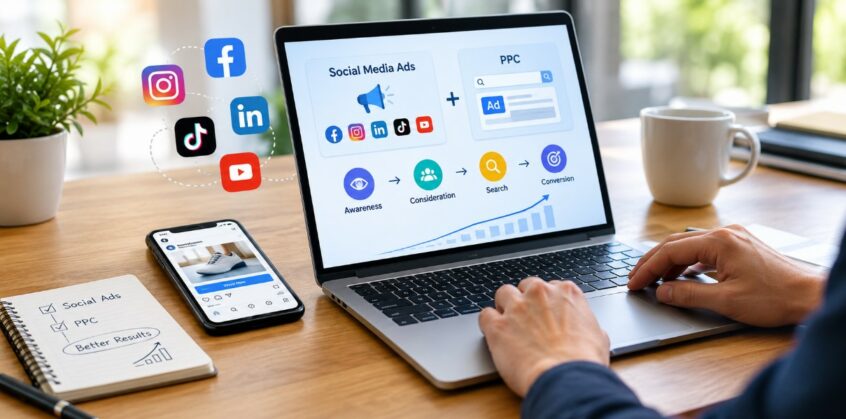
Paid marketing works best when different channels support each other instead of operating separately. Search ads can capture people who are already looking for a product or service, while social platforms can introduce that offer to people earlier in their decision-making process. This creates more opportunities to build awareness, generate interest, and guide potential customers toward conversion.
Short Answer: Social media advertising supports PPC and paid marketing by expanding audience reach, strengthening retargeting, testing creative ideas, and providing useful engagement data. Social campaigns can introduce a brand before someone searches for it, while PPC can capture that demand when the person is ready to take action. Together, these channels can create a more connected paid marketing journey.
For businesses using multiple digital channels, 8 Waves Creative can use this connected approach to help align paid campaigns with audience behavior, creative messaging, and conversion goals.
The relationship between social advertising and PPC becomes particularly useful when businesses track how people move between awareness, consideration, search, and conversion.
Understanding The Relationship Between Social Ads And PPC
Social advertising and PPC often reach people at different stages of the buying journey. Understanding this difference makes it easier to use both channels without treating them as completely separate campaigns.
PPC commonly captures active demand. Someone searches for a service, product, solution, or business and may click an advertisement that matches their search.
Social advertising can work earlier in the journey. A person may see a video, image, offer, or educational message while browsing a social platform. They may not be actively searching at that moment, but the interaction can influence what they remember and search for later.
This creates an important connection between the two channels.
- Social ads can introduce new audiences to a business before they search.
- PPC can capture users when they demonstrate stronger search intent.
- Retargeting can reconnect with people who previously interacted with a campaign.
- Shared messaging can create a more consistent customer experience.
Instead of asking which channel should receive all the attention, marketers can look at how each channel contributes to the overall journey.
Expanding Reach Before Search Intent Appears
One of the biggest benefits of combining paid social with search advertising is the ability to reach people before they know exactly what they want. A search campaign generally depends on someone entering a relevant query. Social advertising can introduce an idea before that search happens.
For example, imagine a person who has noticed a recurring problem with their website but has not yet decided how to fix it. A social ad explaining common website issues may create awareness. Later, that same person might search for a website improvement service.
The social interaction did not necessarily produce the final conversion. However, it may have helped create the awareness that eventually led to the search.
- Awareness campaigns can introduce solutions before users begin researching.
- Educational content can turn an unfamiliar problem into a recognized need.
- Video ads can communicate an idea quickly through visual storytelling.
- Audience engagement can provide signals about topics that attract attention.
This wider reach gives PPC campaigns more potential demand to capture later.
Using Creative Testing To Strengthen Paid Campaigns
Creative testing is another area where social advertising can support a broader paid strategy. Social platforms provide opportunities to test different messages, visuals, formats, offers, and calls to action.
A business might discover that one message receives considerably more engagement than another. That insight can influence future landing pages, search advertisements, remarketing campaigns, or other paid assets.
This does not mean that engagement automatically equals conversion. Instead, engagement can provide an additional signal about what attracts attention.
For example, if several social creatives promote the same service but use different benefits, the strongest response may reveal which benefit deserves more attention in future campaign messaging.
- Test different benefits rather than changing only colors or images.
- Compare educational messages with direct promotional messages.
- Use different hooks to identify what captures attention.
- Connect promising creative ideas with measurable conversion outcomes.
The goal is not simply to create more advertisements. It is to learn which messages deserve further testing across the paid marketing system.
Connecting Audience Data Across Campaigns
Audience information can help marketers understand how different groups respond to advertising. Social campaigns can reveal engagement patterns, while PPC data can show which searches and landing pages generate stronger actions.
Used together, these signals can provide a broader view of audience behavior. For instance, a social campaign may attract strong engagement from a particular audience segment. Marketers can then examine whether related search activity, website visits, lead submissions, or purchases also increase.
Social media management can also focus on maintaining consistent campaign monitoring, creative updates, audience organization, and performance reporting rather than treating social advertising as an isolated activity.
Useful audience signals may include:
- Engagement behavior can reveal which topics attract attention.
- Website visits can show whether advertising creates further interest.
- Search behavior can indicate movement toward active research.
- Conversion data can identify which audiences produce meaningful business actions.
The key is to avoid judging a campaign from a single metric. A complete view considers how different signals connect.
Improving Retargeting Across The Customer Journey
Retargeting becomes particularly valuable when social and search campaigns work together.
Someone may first discover a business through a social ad, visit its website, and leave without converting. A later search could bring that person back through PPC. If the visitor still does not take action, another relevant campaign may provide a useful reminder.
This creates multiple opportunities to reconnect without assuming that every visitor will convert immediately. Social media marketing can support this process by keeping useful content and offers visible to people who have already shown interest.
- Website visitors can receive relevant follow-up messages.
- Previous engagement can help create more relevant audience groups.
- Different messages can be used for new and returning visitors.
- Retargeting can reinforce information already introduced earlier.
Retargeting should still be relevant and controlled. Showing the same advertisement repeatedly can create fatigue, while a changing sequence of useful messages may provide a more natural experience.
Aligning Search And Social Messaging
Consistency matters when users encounter a business across multiple channels. If a person sees one promise in a social ad and a completely different message after clicking a search advertisement, the experience can feel disconnected.
A coordinated approach can make the journey easier to understand. The offer, key benefit, tone, and landing page experience should support one another. This does not mean every advertisement needs identical wording. Instead, the central message should remain recognizable.
For example, a social campaign might introduce a specific business benefit, while a PPC advertisement targets users actively searching for that service. The landing page can then explain the same benefit in greater detail.
- Keep the main value proposition consistent across campaigns.
- Match advertisement language with the landing page experience.
- Use different formats while maintaining the same campaign message.
- Make calls to action clear and relevant to user intent.
A connected message can reduce confusion and make paid campaigns feel more intentional.
Turning Social Insights Into Search Opportunities
Social advertising can reveal questions, reactions, objections, and interests that may not be obvious from search data alone. Comments, engagement patterns, video interactions, and responses to different messages can highlight subjects worth exploring further.
These insights can help marketers identify potential search topics and advertising themes. If a social audience repeatedly responds to a particular problem, marketers can investigate whether related search queries should be incorporated into PPC campaigns or supporting website content.
For businesses developing a broader Pay-Per-Click advertising strategy, this feedback can become another source of campaign ideas.
- Audience questions can reveal useful themes for future advertisements.
- Repeated objections can highlight information gaps on landing pages.
- Popular topics can inspire new search-focused campaign groups.
- Creative responses can help identify stronger messaging angles.
This creates a feedback loop where social activity informs search campaigns and search results provide additional information for future social campaigns.
For more practical ideas on improving campaign efficiency, explore how to improve social media marketing efficiency without losing engagement.
Measuring Performance Beyond Individual Channels
Looking only at platform-level metrics can make paid marketing performance difficult to understand. A social campaign may appear successful because it generates strong engagement, while a search campaign may appear stronger because it produces direct conversions.
Both results can be useful, but they represent different stages of the customer journey. A better approach is to consider how awareness, traffic, engagement, leads, sales, and repeat interactions connect.
Current paid media trends also show why cross-channel measurement matters. Skai reported that in Q2 2026, paid social spending increased 26% year over year while paid search spending increased 17%. Its report also highlighted significant differences in clicks and cost behavior between paid social and paid search.
- Reach measures how widely a campaign is being exposed.
- Engagement shows how audiences interact with creative content.
- Clicks indicate movement from advertisements to owned channels.
- Conversions connect campaign activity with measurable actions.
- Customer value provides context beyond the first conversion.
The right measurement framework depends on the business objective, audience, sales cycle, and conversion process.
Using Social Advertising In A Broader Paid Strategy
Social advertising can also support other forms of digital marketing campaigns in the US by providing additional opportunities to test audiences, offers, creative formats, and messaging.
A connected paid strategy may include search ads, social ads, display advertising, remarketing, video campaigns, and landing page optimization. Each channel can perform a different role while contributing to the same business objective.
This approach can be especially useful when a business needs both demand creation and demand capture.
- Social advertising can help create awareness among new audiences.
- Search advertising can capture users with active intent.
- Remarketing can reconnect with previous visitors.
- Landing pages can turn campaign traffic into measurable actions.
The objective is not to use every available channel. Instead, businesses should identify the channels that fit their audience and goals and then create meaningful connections between them.
Practical Steps For Building A Connected Campaign
A connected paid marketing system does not need to be complicated. Businesses can begin with a clear objective and gradually improve the relationship between social and PPC campaigns.
Start by identifying the action that matters most, such as generating leads, encouraging bookings, increasing product sales, or driving qualified website visits.
Next, define the role of each channel. Decide what social advertising should accomplish and what PPC should capture.
Then create consistent messaging and establish tracking before launching campaigns.
- Set one primary business objective for each campaign group.
- Define the audience and stage of the buying journey.
- Create separate messages for awareness and high-intent searches.
- Track meaningful actions rather than relying only on clicks.
- Review results regularly and adjust underperforming elements.
- Use successful insights to guide future campaign testing.
This process makes it easier to identify what is working and where improvements may be needed.
Common Mistakes That Reduce Paid Marketing Performance
Even well-planned campaigns can lose effectiveness when channels are managed independently. One common mistake is using different offers or messages across social and search without considering the overall customer journey.
Another issue is focusing too heavily on surface-level metrics. A high number of clicks may look positive, but those clicks need to lead to useful actions to support business objectives.
Creative fatigue can also reduce performance when audiences repeatedly see the same advertisements.
- Sending every advertisement to the same landing page can weaken relevance.
- Using identical creative for too long can reduce audience attention.
- Optimizing only for clicks can hide weak conversion performance.
- Ignoring search and social data together can limit useful insights.
Regular testing and cross-channel analysis can help identify these issues before they become larger problems.
Build A More Connected Paid Marketing Journey
Social advertising and PPC do not need to compete for attention. They can work as complementary parts of a broader paid marketing system, with social campaigns helping create awareness and engagement while search campaigns capture active demand.
The strongest approach is built around clear objectives, consistent messaging, meaningful audience signals, strong creative testing, useful landing pages, and reliable conversion tracking. As paid platforms continue to introduce more automation and AI-driven campaign features, creative quality, measurement, and clear business goals remain important parts of campaign management.
If your campaigns are producing data but the channels are not working together, contact us today to explore ways to create a more connected paid marketing strategy. 8 Waves Creative can help bring social advertising, PPC, creative messaging, and conversion-focused marketing into a more coordinated approach.
Frequently Asked Questions
Can Social Media Ads Increase Google Search Traffic?
They can contribute to increased interest in a brand or offer, which may lead some users to search for that business later. However, the relationship varies by audience, campaign, industry, and measurement setup. It should be measured rather than assumed.
Should Small Businesses Run PPC And Social Ads Together?
They can, provided each channel has a clear purpose and the business can track meaningful outcomes. Starting with focused campaigns and gradually expanding based on performance can make the strategy easier to manage.
How Often Should Social Media Ads Be Changed?
There is no universal schedule. Creative should be reviewed based on performance, audience response, frequency, campaign duration, and signs of fatigue. Testing different concepts is generally more useful than changing advertisements simply because a certain number of days has passed.
What Is The Difference Between Paid Social And PPC?
Paid social usually refers to advertisements displayed through social platforms, while PPC is commonly associated with paid search where advertisers bid for clicks. In practice, PPC can also be used more broadly to describe pay-per-click advertising across different platforms.
Do Social Media Ads Help With Remarketing?
Yes. Social platforms can support remarketing to eligible audiences who have previously interacted with a website, advertisement, or social content. The exact audience options depend on the platform, privacy settings, tracking implementation, and campaign configuration.
What Should Be Tracked In A Paid Social Campaign?
Useful metrics depend on the objective. Common measurements include reach, impressions, engagement, clicks, conversion rate, leads, purchases, cost per acquisition, and revenue. The most useful metrics are those connected to the actual business goal.

As Senior Project Manager at 8Waves Creative, Sharon brings a strategic, organized approach to managing complex marketing initiatives. With extensive corporate marketing experience across a range of channels, she understands how the pieces fit together to create cohesive, effective campaigns. She keeps projects moving, teams aligned, and the details on track from start to finish.
Outside of work, Sharon enjoys spending time at the beach and cheering on her children from the sidelines.